

How to Choose the Right Slewing Bearing for Construction Equipment?
January 17, 2025
How to Lubricate a Slewing Drive: The Ultimate Maintenance Guide
March 6, 2025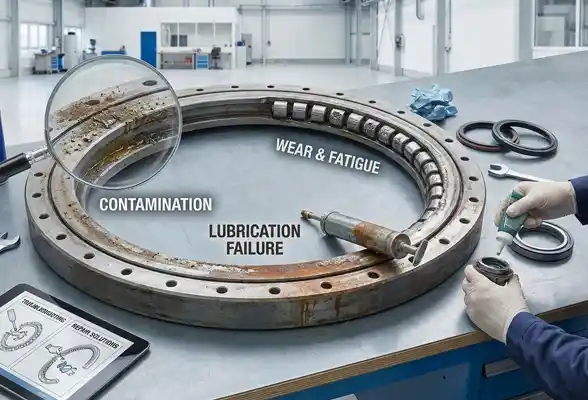
In the heavy equipment industry, silence is golden. A well-maintained slewing ring bearing should operate smoothly with a consistent, low-level hum. When that hum turns into a grind, a click, or a pop, your machine is trying to tell you something.
Noise is rarely a random occurrence; it is a symptom of distress. Whether you operate a hydraulic excavator, a tower crane, or a wind turbine, accurately diagnosing the source of the noise is crucial. Misinterpreting these signs can lead to unnecessary component replacement or, worse, a catastrophic structural failure that endangers personnel. This guide dissects the acoustic signatures of bearing failure and outlines the immediate steps you must take.
1. Decoding the Sound: What Do the Noises Mean?
Not all bearing noises are created equal. The pitch, frequency, and timing of the sound can reveal the specific type of damage occurring inside the raceway.
Table 1: Slewing Ring Bearing Noise Diagnostic Chart
| Noise Type | Sound Description | Likely Root Cause | Severity Level |
| Grinding / Crunching | Constant rough sound, like sand in a mixer. | Contamination: Dirt, sand, or water has breached the seals and mixed with the grease. | High: Immediate grease purge required. |
| Rhythmic Clicking | A sharp "tick" that repeats at regular intervals during rotation. | Spalling: A piece of the raceway or a rolling element has flaked off (pitting). | Critical: The bearing structure is compromised. |
| Squealing | High-pitched metal-on-metal screech. | Lubrication Starvation: The oil film has broken down, causing dry friction. | High: Stop operation and lubricate immediately. |
| Loud Popping / Banging | Sudden loud noises when changing direction or stopping. | Mounting Issues: Loose bolts or a distorted mounting structure causing the ring to flex. | Critical: Safety hazard. Check torque immediately. |
2. The “Grease Autopsy”: Visual Confirmation
If you hear noise, your next step is not to just add more grease—it is to inspect the old grease. The lubricant acts as the bearing’s “blood,” carrying evidence of internal health.
How to Perform a Grease Analysis:

- Locate the Purge Points: Identify the seal lips where old grease exits.
- Sample Collection: Wipe a sample of the used grease onto a clean white rag or a piece of white paper.
- Tactile Test: Rub the grease between your gloved fingers. Does it feel gritty? Grit indicates sand or dirt ingress (seal failure).
- Visual Inspection: Look for metallic particles.
- Fine Grey/Silver Dust: This indicates normal wear or mild fretting.
Large Flakes or Chips: If you see shiny metal chips (macroscopic particles), the case-hardened layer of the raceway is disintegrating. The slewing ring bearing has reached the end of its fatigue life.
Pro Tip: If you find metal chips, do not simply purge and continue working. The bearing must be scheduled for replacement or remanufacturing immediately.
3. Checking for Excessive Play (Clearance)
Noise often accompanies increased internal clearance. As the raceway wears down, the “play” between the inner and outer rings increases. When the load shifts (e.g., an excavator bucket digs into the ground), the rings slam against each other, creating noise.
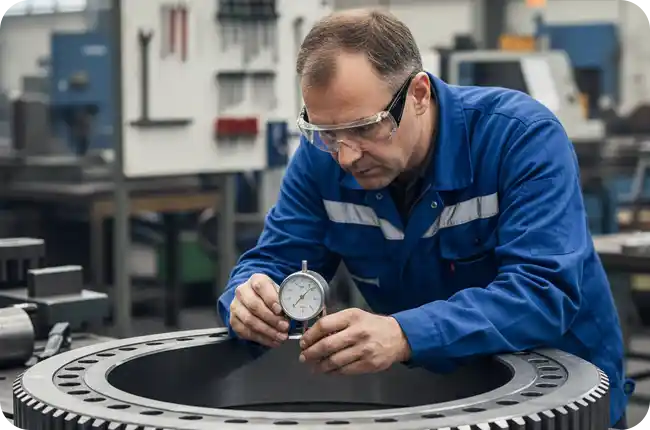
- The Dial Indicator Test: To verify if wear is the culprit, you must measure the axial clearance (tilting play).
- Mount the Indicator: Attach a magnetic base dial indicator to the carbody (lower structure) with the probe touching the bottom of the upper structure bearing race.
- Zero the Gauge: Set the gauge to zero.
- Apply Load: Use the boom to lift the upper structure slightly (safety first!).
- Read the Movement: Note the deflection reading on the gauge.
Compare to Spec: Compare your reading to the manufacturer’s “Max Allowable Wear” limit for that specific slewing ring bearing model. If the movement exceeds the limit (often around 1.5mm to 3mm depending on size), the noise is due to structural wear.
4. Root Causes Beyond the Bearing: The Mounting Surface
Sometimes, the bearing is the victim, not the criminal. A slewing ring bearing requires a mounting surface that is rigid and perfectly flat.
If the machine frame is warped or the mounting pads are uneven, tightening the bolts will force the bearing ring to distort into the shape of the uneven surface. This distortion creates “tight spots” in the raceway.

- Symptom: The bearing makes noise only at specific angles of rotation (e.g., it grinds at 90° but is silent at 180°).
- Solution: You may need to machine the mounting surface flat or use epoxy chocking compounds (like Chockfast) to create a level interface before installing a new bearing.
5. Repair vs. Replacement: Making the Call
Once you have diagnosed the noise, you have three options:
- The “Purge” (Low Severity): If the noise is a soft grinding and the grease analysis shows only dirt (no metal), you might save the bearing. Pump fresh grease into the fittings while rotating the bearing slowly. Continue until only clean, fresh grease comes out of the seals. This flushes out the contaminants.
- Seal Replacement (Medium Severity): If the seals are torn but the bearing is otherwise smooth, replace the seals immediately to prevent further ingress.
- Full Replacement (High Severity): If there is clicking, popping, or metal chips in the grease, the slewing ring bearing cannot be field-repaired. It must be replaced. Attempting to weld or repair a spalled raceway on-site is dangerous and usually ineffective due to the precise heat treatment of the steel.
Conclusion
A noisy slewing ring bearing is a ticking clock. Whether it is the subtle grinding of contamination or the rhythmic click of fatigue spalling, early detection is the key to saving money. By combining auditory monitoring with regular grease analysis and clearance checks, you can move from “reactive fire-fighting” to “proactive maintenance.”
Remember, the cost of a planned bearing replacement is significant, but it is a fraction of the cost of an emergency breakdown that strands your equipment on a job site for weeks.